This is exactly the kind of feature DeAI needs if it wants to onboard more than just power users.
Running AI infrastructure shouldn't require everyone to own a GPU or know how to operate a node.
That's why I like what $CNX is doing with delegated staking.
For anyone unfamiliar, @crynuxio is building a permissionless AI compute network powered by everyday hardware.
Home PCs with NVIDIA GPUs.
Apple Silicon Macs.
Cloud instances.
Instead of relying on massive centralized data centers, AI workloads like inference, fine-tuning, and image generation are distributed across a global network of edge devices.
Now, if you hold $CNX, you don't need to run hardware to participate.
You can simply:
• Connect your wallet to the Crynux Portal
• Browse available node operators
• Delegate your $CNX
The operator runs the infrastructure.
You earn a share of the rewards generated from real AI compute tasks.
It's a much lower barrier to entry.
Not everyone has an 8GB+ GPU sitting idle.
Not everyone wants to deal with setup, monitoring, or maintenance.
Delegated staking lets those users still participate in the network.
It also creates better alignment.
Node operators receive more stake backing reliable infrastructure.
Delegators earn without operational overhead.
As more AI workloads flow through the network, both benefit.

Cryptonex (CNX)
Cryptonex CNX Price History USD
Own CNX Now
Buy and sell CNX easily and securely on BitMart.Cryptonex X Insight
Did you know you can stake your $CNX without running your own node?
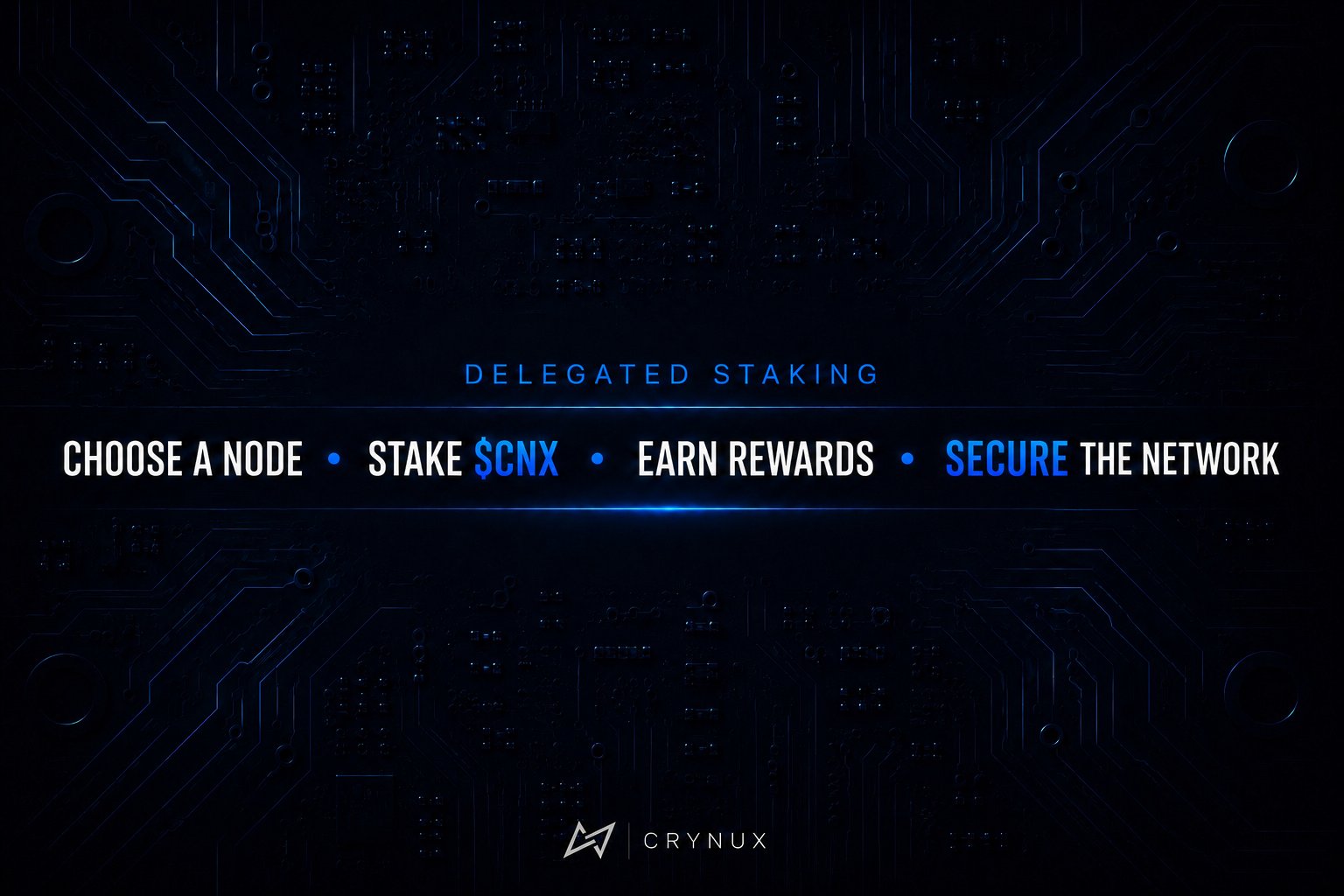
With delegated staking, you don’t need specialized hardware or technical expertise. Simply choose a node, stake your $CNX, and earn a share of the network rewards while helping secure the Crynux network.
Get started here: https://t.co/p9Jwckeai0
Most AI projects sell the same pitch
Spare GPUs, token rewards and "decentralized."
Nobody explains how you actually verify anonymous machines did the AI work honestly.
We asked @crynuxio that exact question on our AMA last week:
https://t.co/moRk7wIMfo
Their answer is vssML: deterministic execution + secret task sampling + ZK proofs on the sampling itself (proving the whole model isn't feasible yet).
Nodes never know which tasks get checked, so they can't selectively cheat. That consensus-first approach is what actually separates them from the $TAO / $IO crowd, not just another GPU marketplace with a token bolted on.
Their Lithium mainnet is live.
You can run a node, delegate stake to one, or plug into their OpenAI-compatible API right now. T
he long game: make smaller open-source models cheap and accessible instead of chasing OpenAI at the frontier.
In the AMA, Luke goes deep on the consensus design, why ZK proofs failed for full neural nets, how task pricing works (think gas fees, not fixed pricing), the node onboarding steps, and where they see $CNX and the network in 4-5 years.
If you're running a $CNX node, your GPU isn't what determines your earnings.
Your QoS score does.
And the new QoS Diagnostics tool finally shows you why your score is moving instead of leaving you guessing.
QoS (Quality of Service) is the key metric the network uses when assigning AI workloads.
A higher score means:
• More tasks assigned to your node
• Better earning potential
• Greater network trust
It's calculated using two components:
Long-term Performance tracks your rolling performance across roughly the last 50 validation tasks. Faster, more reliable execution leads to a higher score.
Short-term Reliability (H) measures your current node health. It starts at 1.0, drops sharply after timeouts, and gradually recovers through successful task completion.
If H falls below 0.1, your node won't receive new tasks until it recovers.
Until now, operators could see their QoS changing but had no way to understand why.
Was it:
• A network issue?
• A timeout?
• Thermal throttling?
• Hardware instability?
Now you can see exactly when your score changed and what likely caused it.
That's a much bigger upgrade than it sounds.
It lets operators actually optimize their setups instead of troubleshooting in the dark.
It also improves the network itself. Reliable nodes receive more work.
Temporary issues recover automatically.
Poor-performing nodes gradually lose priority instead of hurting overall service quality.
That's exactly how a decentralized AI network should evolve.
Running a Crynux node is already one of the easiest ways to contribute spare GPU compute to decentralized AI.
But hardware alone isn't enough anymore.
Consistency wins.
Small improvements to cooling, internet stability, or system performance could translate directly into more tasks and better rewards.
This is the kind of infrastructure improvement that helps permissionless AI networks compete with centralized cloud providers.
If you're running a node, it's probably worth checking your QoS history today.
You might find there's more room for optimization than you expected.
Understanding your QoS score just got a lot easier.
The new QoS Diagnostics tool gives you a complete history of your QoS score, making it easier to identify what caused an increase or decrease to your score so you can optimize your node’s performance.
To get started:
• Connect your node wallet to the Crynux Portal.
• Open the dropdown menu in the top-right corner.
• Select “QoS Diagnostics.”
Better insights lead to better performance.
Price Prediction
When is a good time to buy CNX? Should I buy or sell CNX now?
Beacon Prediction
Probabilistic Price Forecast (Next 24 Hours)This prediction is an experimental technical product and is provided for reference purposes only. It does not constitute investment advice. Unexpected real-world events may significantly impact market behavior. Traders should make decisions with caution.
Explore More
BM Discovery
New Listing