Rewards
Futures Daily Draw
100% Chance To Win With Daily Trades
Spot Daily Draw
Win 8,888 USDT In Grand Prizes
Mobile Top-Up
Top up mobiles easily, online, secure
Send
Send money globally, fast and secure
BitMart Mall
Live on crypto

ADI (ADI)
$ 8.07 (ADI/USD)
-0.62%
24H
ADI Live Price data
Today's price of ADI Is $ 8.07 (ADI/USD). With A Market Cap Of $ 76.12M USD. 24-Hour Trading Volume Of $ 4.73M USD, A 24-Hour Price Change Of -0.62%, And A Circulating Supply Of 9.43M ADI.
ADI ADI Price History USD
Track the price of ADI for today, 7 days, 30 days and 90 days
Period
Change
Change (%)
Today
$ 0.049
-0.62%
7days
$ 0.27
-3.35%
30days
$ 0.25
-3.12%
90days
$ 2.12
35.57%
Own ADI Now
Buy and sell ADI easily and securely on BitMart.
ADI Market Information
$ 8.02 24h Range $ 8.12
All time high
$ 8.89
All time low
$ 0.97
24h Change
-0.62%
24h Vol
$ 4,734,276.51
Circulating supply
9.43M
ADI
Market cap
$ 76.12M
Max supply
1.00B
ADI
Fully diluted market cap
$ 8.07B
Trade ADI

ADI X Insight

Stacy Muur
OnChain_Analyst
Tokenomics_Expert
B
 77.7K @stacy_muur
 Bullish
ADIChain launched a staking program offering up to 18% APY and multiple rewards, encouraging user participation.
Stacy Muur
OnChain_Analyst
Tokenomics_Expert
B
77.7K @stacy_muur Recently, @ADIChain_ launched its staking program, allowing you to lock your $ADI tokens and earn rewards along with juicy multipliers.
The program launched with 3 tiers:
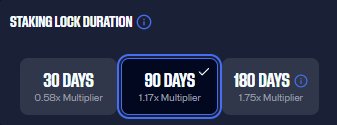
→ 30 days: 1x reward multiplier and around 6% indicative APY
→ 90 days: 2x reward multiplier and around 12% indicative APY
→ 180 days: 3x reward multiplier and up to 18% indicative APY (launch window for this tier has closed)
Also worth knowing that the tokens remain locked until the term ends, and all rewards come from a fixed pool of 250K $ADI, without constant inflationary pressure.
The displayed APY moves within a 6-18% band, and while the pool is still filling, actual accrual can even run above the displayed rate.
NFA, but if you've got any $ADI lying around, you might want to consider putting it to work.
You can check the live data on @ADI_Foundation's staking dashboard: https://t.co/jIc6hhXxqd
 123
123
 18
18
 6.6K
6.6K
2026-08-01 08:07
Trend of ADI after release
Bullish
ADIChain launched a staking program offering up to 18% APY and multiple rewards, encouraging user participation.

ATOMS
Researcher
Educator
C
62.3K @atoms_res Bullish
ADI staking offers up to 18% annual yield, the project is backed by IHC and has major players participating in ecosystem development.
Took a look at $ADI staking
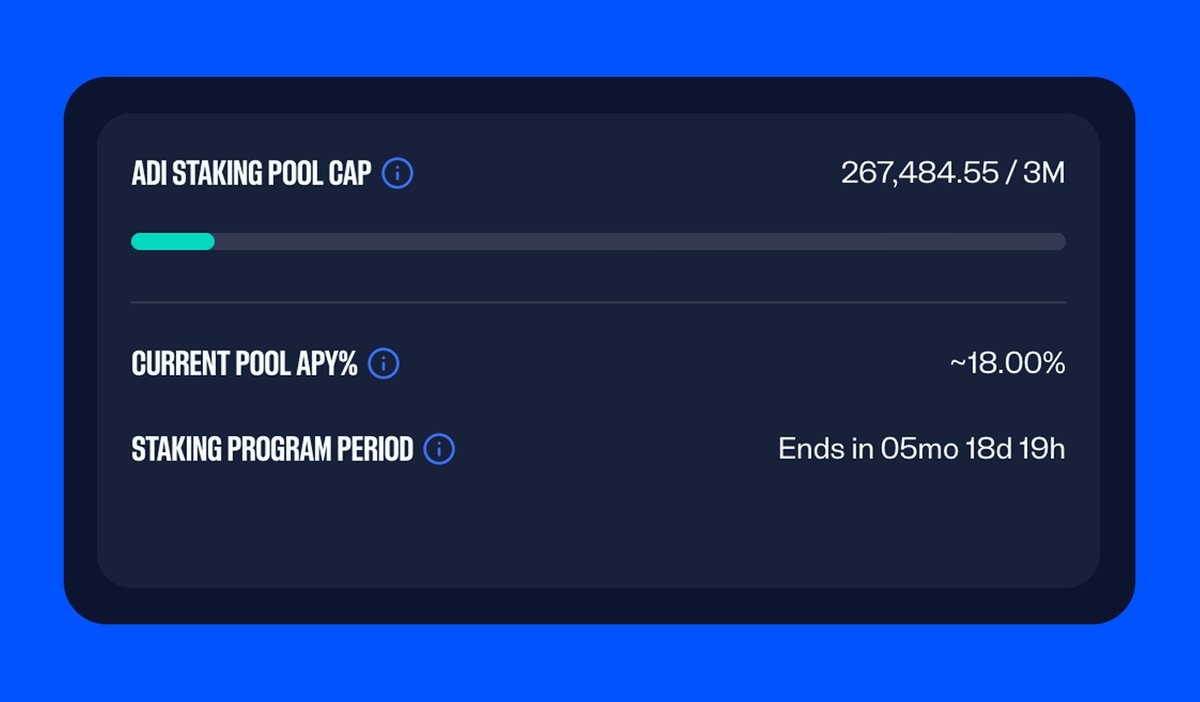
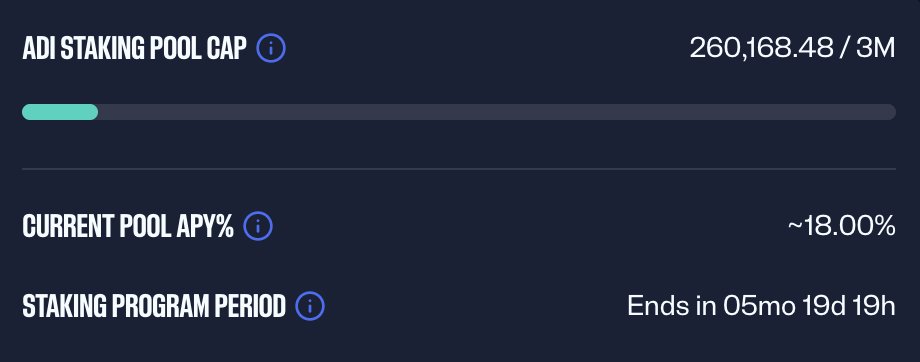
The staking pool is fixed at 250k $ADI with a 3M $ADI cap
Rewards are distributed from that fixed pool, and APY changes as participation grows
There are 3 staking options:
• 30 days: ~6% APY (1x reward weight)
• 90 days: ~12% APY (2x reward weight)
• 180 days: ~18% APY (3x reward weight)
Minimum stake is 1,000 $ADI
Non-custodial, rewards are paid in $ADI
Top-ups are allowed (subject to the cap and program window), but each new deposit starts its own lock period
+ another point worth mentioning
@ADIChain_ is backed by IHC (~$240B), with BlackRock, Mastercard and Franklin Templeton already building in the ecosystem
It’s built for payments, settlements and tokenized real-world assets, with $ADI used as the network’s gas token
Worth checking @ADI_Foundation if you want to read more
And one thing to keep in mind: there’s no early unstaking
So if you decide to stake, make sure you’re comfortable with the lock period
🔗 Stake here: https://t.co/oS9bdasOXA
 52
16
4.8K
52
16
4.8K
2026-08-01 08:37
Trend of ADI after release
Bullish
ADI staking offers up to 18% annual yield, the project is backed by IHC and has major players participating in ecosystem development.

DeFi Warhol
DeFi_Expert
OnChain_Analyst
B
51.3K @Defi_Warhol Extremely Bullish
作者将ADI加入90天质押策略,看好12-18%APY及RWA领域投资机会。
DeFi Warhol
DeFi_Expert
OnChain_Analyst
B
51.3K @Defi_Warhol I'm gonna add $ADI to my staking strategy.
Going with the 90-day tier, 2x reward multiplier, and 12% indicative APY (but the yield can go up to 18% APY on longer lockups). The 180-day lock closed a few days after launch, so this is the highest multiplier still open.
The main reason is exposure to institutional payments and RWAs, a sector I want more of in my portfolio.
Two things worth knowing. Minimum entry is 1,000 $ADI, around $7K at current prices, and there's no early exit for the full 90 days.
The team allocated 250,000 $ADI for rewards, funded once, without constant inflationary emissions.
I'll come back and share the actual results once the position unlocks.
NFA, but if you've got any $ADI lying around or plan on buying some, definitely a good option.
 84
14
4.7K
84
14
4.7K
2026-08-01 06:57
Trend of ADI after release
Extremely Bullish
作者将ADI加入90天质押策略,看好12-18%APY及RWA领域投资机会。
Price Prediction
When is a good time to buy ADI? Should I buy or sell ADI now?
When deciding whether it’s a good time to buy or sell ADI (ADI), it’s important to first align with your own trading strategy and risk profile.Long-term investors and short-term traders often interpret market conditions differently, so your decision should reflect your personal approach. According to the latest ADI 4-hour technical analysis, the current trading signal is Hold. According to the latest ADI 1-day technical analysis, the current signal is Buy.

Beacon Prediction
Probabilistic Price Forecast (Next 24 Hours)Beacon Prediction Disclaimer
The data results displayed on this page are analyzed based on actual trading data (OHLCV) of the selected trading pair along with corresponding technical indicators.
This prediction is an experimental technical product and is provided for reference purposes only. It does not constitute investment advice. Unexpected real-world events may significantly impact market behavior. Traders should make decisions with caution.
This prediction is an experimental technical product and is provided for reference purposes only. It does not constitute investment advice. Unexpected real-world events may significantly impact market behavior. Traders should make decisions with caution.
About ADI
ADI (ADI) is a cryptocurrency launched in 2025. ADI has a current supply of 999,999,999 with 9,434,511.21887059 in circulation. The last known price of ADI is 8.31635337 USD and is down -0.22 over the last 24 hours. It is currently trading on 17 active market(s) with $4,675,662.25 traded over the last 24 hours. More information can be found at https://token.adi.foundation/.
Read More
Official Links
Chain Explorer