
Ok @HopExchange is deffo coming back in a BIG way!!
Rewards
Futures Daily Draw
100% Chance To Win With Daily Trades
Spot Daily Draw
Win 8,888 USDT In Grand Prizes
Mobile Top-Up
Top up mobiles easily, online, secure
Send
Send money globally, fast and secure
BitMart Mall
Live on crypto

Hop Protocol (HOP)
--
0%
24H
Hop Protocol HOP Price History USD
Track the price of Hop Protocol for today, 7 days, 30 days and 90 days
Period
Change
Change (%)
Today
--
--
7days
--
--
30days
--
--
90days
$ 0.12
-99.40%
Own HOP Now
Buy and sell HOP easily and securely on BitMart.
Hop Protocol Market Information
$ 0.00012 24h Range $ 3,331.42
All time high
$ 3,331.42
All time low
$ 0.00012
24h Change
24h Vol
0
Circulating supply
0.00
HOP
Market cap
0
Max supply
1.00B
HOP
Fully diluted market cap
0
Trade HOP
Hop Protocol X Insight

Adeniyi.sui
Founder
Dev
B
 86.5K @EmanAbio
 Extremely Bullish
The tweet author is strongly bullish on Hop Protocol (HOP) making a strong comeback, implying its future performance will significantly rise.
 310
310
 78
78
 31.3K
31.3K
2025-10-23 01:25
Trend of HOP after release
Extremely Bullish
The tweet author is strongly bullish on Hop Protocol (HOP) making a strong comeback, implying its future performance will significantly rise.

David Crypto Scam Hunter
OnChain_Analyst
Security_Expert
C
35.4K @CryptoScamHuntO Bearish
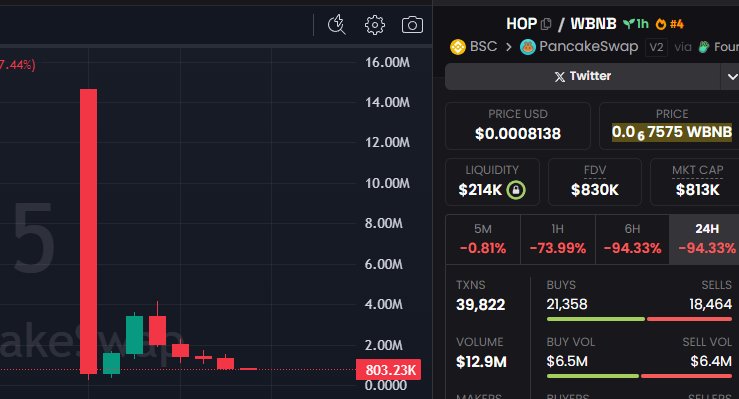
$HOP token plummeted over 94% on BSC within 24 hours. The tweet warns it as a potential scam, reminding investors to avoid risks.
$HOP 🚨🚨🚨
0x444449aaFF4D55d57c4b291D2095E0C11458597C
Where are the BSC defenders now? 👀
They said “No scams on BSC!” 😂💀 https://t.co/ytWg0xmcIX
 11
5
2.8K
11
5
2.8K
2025-10-19 12:49
Trend of HOP after release
Extremely Bearish
$HOP token plummeted over 94% on BSC within 24 hours. The tweet warns it as a potential scam, reminding investors to avoid risks.

Ignacio Palomera
Founder
Tokenomics_Expert
B
84.1K @MrIPalomera Extremely Bearish
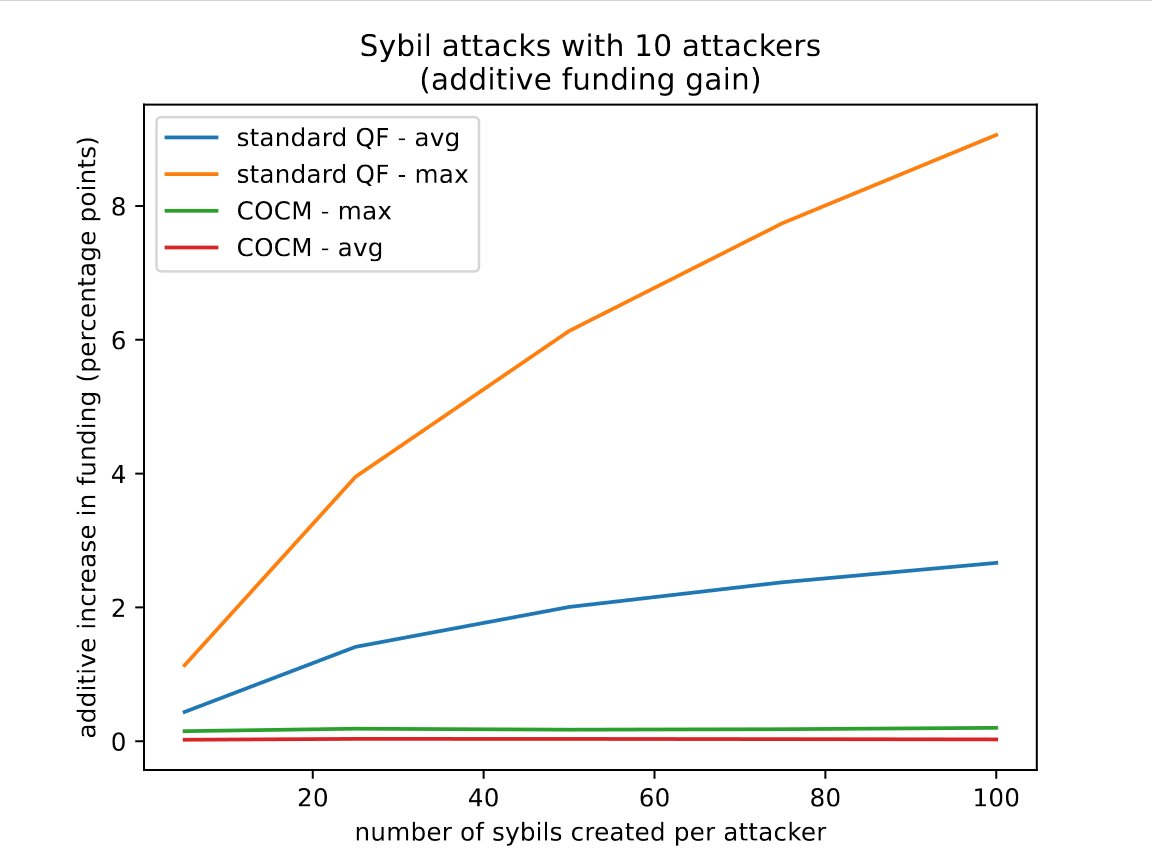
Web3 scoring systems are vulnerable to Sybil attacks. The image shows that under standard QF mechanisms, attackers can gain significant financial benefits, indicating investment risks.
Every Web3 score has becomes a target.
It is about time we stop dealing with these liabilities.
The best example is Hop Protocol’s airdrop eligibility criteria. They wanted to be bridging volume and DAO forum activity and it seemed airtight.
But one audit revealed 22,000 wallets using gas-optimized scripts to simulate volume. The top 5 “contributors” were Sybil rings (rewarded
& not removed).
Scoring systems in Web3 often over index on surface inputs: clicks, commits, proposals. But in game theory any public metric becomes predictable and predictability creates arbitrage.
Reputation mining in DAOs is a textbook example.
Look at Gitcoin Grants.
By late 2023 61% of matching pool claims came from wallets created within the last two weeks of each round and Sybil-resistant voting was advertised but the civil engineering was missing.
Even Web2 has not escaped.
-LinkedIn’s 2024 skill badge system saw a spike in auto generated certifications.
-HackerRank noticed a 30% rise in AI-cheated assessments after ChatGPT’s public release.
You can’t make systems un-gameable.
But you can make cheating expensive.
We need:
→ Score only what is hard to fake.
→ Audit on-chain with off-chain proof.
→ Bake cost into access.
Good systems are built on friction.
Enough to make gaming the game cost more than playing it.
 220
14
13.4K
220
14
13.4K
2025-06-25 17:50
Trend of HOP after release
Bearish
Web3 scoring systems are vulnerable to Sybil attacks. The image shows that under standard QF mechanisms, attackers can gain significant financial benefits, indicating investment risks.
Price Prediction
When is a good time to buy HOP? Should I buy or sell HOP now?
When deciding whether it’s a good time to buy or sell Hop Protocol (HOP), it’s important to first align with your own trading strategy and risk profile.Long-term investors and short-term traders often interpret market conditions differently, so your decision should reflect your personal approach. According to the latest HOP 1-day technical analysis, the current signal is Hold.

Beacon Prediction
Probabilistic Price Forecast (Next 24 Hours)Beacon Prediction Disclaimer
The data results displayed on this page are analyzed based on actual trading data (OHLCV) of the selected trading pair along with corresponding technical indicators.
This prediction is an experimental technical product and is provided for reference purposes only. It does not constitute investment advice. Unexpected real-world events may significantly impact market behavior. Traders should make decisions with caution.
This prediction is an experimental technical product and is provided for reference purposes only. It does not constitute investment advice. Unexpected real-world events may significantly impact market behavior. Traders should make decisions with caution.
About Hop Protocol
Hop Protocol (HOP) is a cryptocurrency launched in 2021and operates on the Ethereum platform. Hop Protocol has a current supply of 1,000,000,000 with 0 in circulation. The last known price of Hop Protocol is 0.00077826 USD and is up 0.00 over the last 24 hours. More information can be found at https://hop.exchange/.
Read More
Official Links
Chain Explorer