活動
合約每日抽獎
每日交易100%中獎
現貨每日抽獎
抽 8,888 USDT 豪禮
投票上幣
投票支持區塊鏈資產,賺取空投
機構
專為機構打造的解決方案
VIP
解鎖專屬福利
BitMart 學院
快速學習入門交易,瞭解區塊鏈知識
BitMart 大使
學習、建設 Web3,從 BitMart 起航
BitMart Travel
全球旅行服務,一站式預訂
BitMart話費充值
話費、流量、套餐便攜充值
轉帳
安全便捷,隨時隨地全球匯款
幣市商城
用加密貨幣滿足您的一切消費需求

Sign (SIGN)
$ 0.0099 (SIGN/USD)
0.00%
24H
Sign 實時價格數據
今日Sign的實時價格為$ 0.0099 (SIGN/USD), 當前市值為 $ 23.86M USD。 24小時的成交量為 $ 3.35M USD。 過去24小時內漲跌幅為 +0.00%, 流通量為 2.39B SIGN。
Sign SIGN 價格歷史 USD
跟蹤 Sign 的今日價格、7天、30天和90天價格
週期
漲跌
漲跌幅 (%)
今日
$ 0
0.00%
7日
$ 0
0.00%
30日
$ 0.00046
4.93%
90日
$ 0.0013
15.34%

Sign 市場信息
$ 0.0099 24小時價格浮動區間 $ 0.0099
歷史最高
$ 0.059
歷史最低
$ 0.0062
24小時漲跌幅
0.00%
24小時交易量
$ 3,352,964.75
流通供給
2.38B
SIGN
市值
$ 23.86M
最大供給
10.00B
SIGN
完全稀釋的市值
$ 99.98M
交易 SIGN

Sign 社交媒體動態

Krahs🦈☂️Solstice✨
Community_Lead
Media
B
 3.4K @pc970930
 中性
Sign will host a Korean AMA in July, sharing the latest developments and answering questions.

코인소년 COINBOY🦅 D
17.8K @coinboy717 CoinBoy X Sign July AMA (conducted in Korean)
https://t.co/4LpXj1bnny
"Sharing recent Sign updates & answering your questions"
 36
36
 12
12
 976
976
2026-07-23 11:37
發佈後SIGN走勢
中性
Sign will host a Korean AMA in July, sharing the latest developments and answering questions.

Xin
Founder
Regulatory_Expert
B
19.4K @realyanxin 看漲
SIGN launches soft-start forward claim market

Sign D
280.4K @Sign Forward Claim is now live in soft launch.
Locked $SIGN can now be listed and sold before it unlocks.
A dedicated forward market for vesting allocations.
Sellers list. Buyers buy. We settle daily.
🔗 https://t.co/qyujxbWUzo
48
10
9.1K
2026-07-18 14:37
發佈後SIGN走勢
看漲
SIGN launches soft-start forward claim market

Crypto Solutions 🕊️
Founder
DeFi_Expert
C
40.0K @creptosolutions 看漲
SIGN team adjusts token unlock plan, aiming to reduce sell pressure and promote long‑term health.
This is a thoughtful move by the SIGN team. Rather than letting monthly unlocks create constant sell pressure, they've restructured the schedule into more manageable liquidity events without extending the overall vesting timeline or giving anyone preferential treatment.
Managing tokenomics after launch is never easy, especially when market conditions are unpredictable. Credit to the team for listening to stakeholders, staying transparent, and making a decision aimed at supporting long-term ecosystem health. That's the kind of execution that builds confidence over time.
Sign D
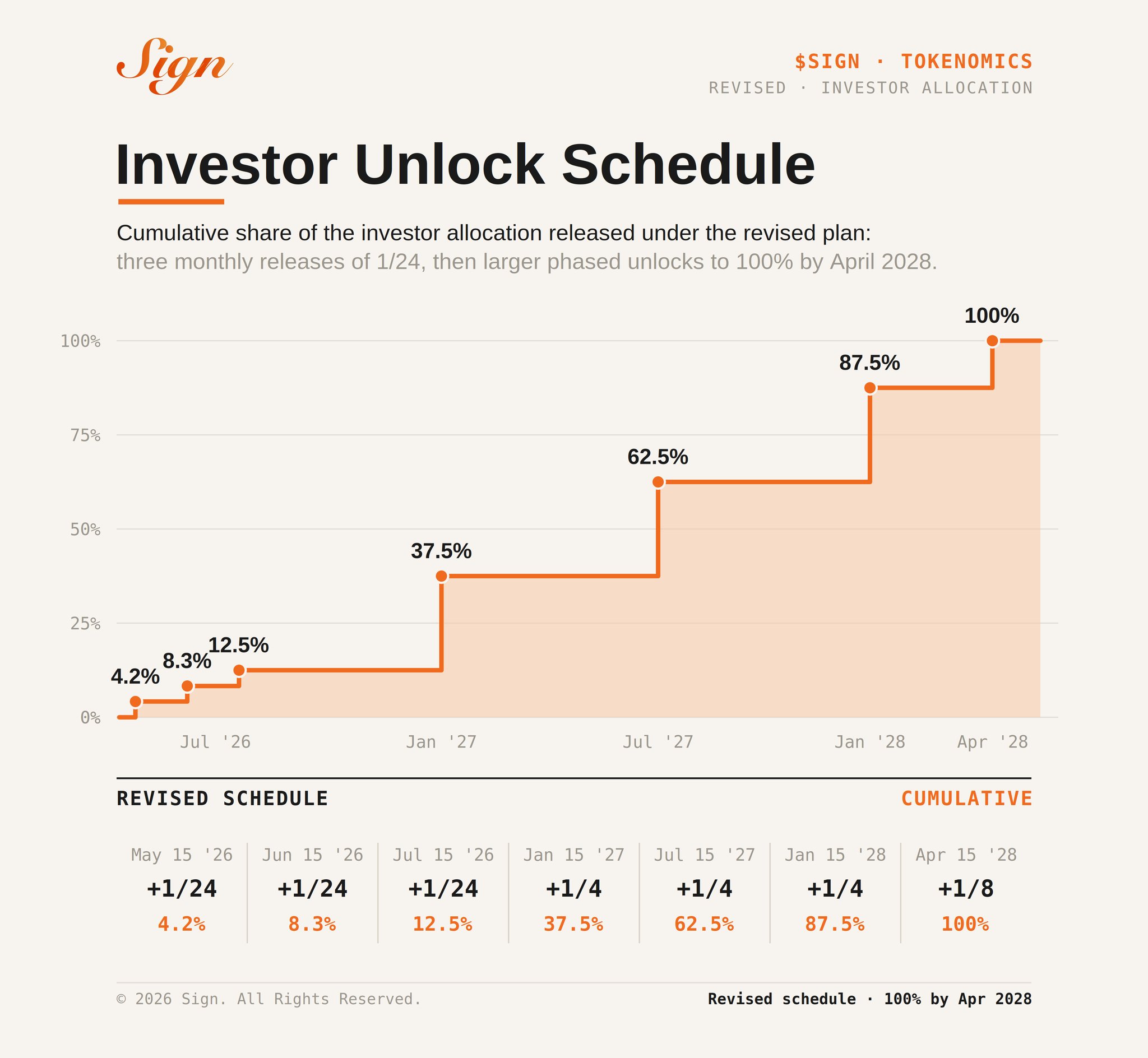
280.4K @Sign Following consensus from Sign Foundation and the majority of our backers, we are updating the $SIGN token unlock schedule.
The first three unlocks remain unchanged: 1/24 monthly through July 2026.
After that, unlocks will move into spaced tranches:
• Jan 15, 2027: 1/4
• Jul 15, 2027: 1/4
• Jan 15, 2028: 1/4
• Apr 15, 2028: final 1/8
The revised schedule is being synced to CoinMarketCap
https://t.co/3G87styC64
All investor and early contributor tokens remain fully unlocked by April 15, 2028. This is a timing restructure, not an extension. There is no preferential acceleration.
The purpose is to reduce continuous monthly overhang and turn unlocks into managed liquidity events aligned with stronger business and market windows.
We are also launching Forward Claim, a dedicated venue for locked tokens, allowing eligible holders to rebalance through an OTC-style forward market without impacting spot liquidity.
More details will follow.
 6
1
1.9K
6
1
1.9K
2026-07-02 17:37
發佈後SIGN走勢
看漲
SIGN team adjusts token unlock plan, aiming to reduce sell pressure and promote long‑term health.
價格預測
什麼時候是購買SIGN的好時機?我應該現在買入還是賣出SIGN?
在判斷現在是否是買入或賣出 Sign (SIGN) 的合適時機時,首先需要結合自身的交易策略和風險承受能力。長期投資者與短期交易者對市場信號的解讀往往不同,因此建議根據個人交易計劃做出決策。 根據最新的 SIGN 4 小時技術分析,當前交易信號為持有。 根據最新的 SIGN 1 天技術分析,當前交易信號為持有。

Beacon預測
概率價格預測(未來24小時)Beacon預測免責聲明
當面頁面的數據結果基於當前交易對的實際交易數據(OCHLV)和相應的指標計算,然後進行分析得出結果。
此預測為實驗性技術產品,僅供參考,不構成投資建議。現實生活中的任何突發事件都可能對交易行為產生重大影響,因此交易者應謹慎決策。
此預測為實驗性技術產品,僅供參考,不構成投資建議。現實生活中的任何突發事件都可能對交易行為產生重大影響,因此交易者應謹慎決策。
關於 Sign
Sign (SIGN) is a cryptocurrency launched in 2025and operates on the Ethereum platform. Sign has a current supply of 10,000,000,000 with 2,386,666,666 in circulation. The last known price of Sign is 0.01386348 USD and is up 0.11 over the last 24 hours. It is currently trading on 192 active market(s) with $5,740,196.12 traded over the last 24 hours. More information can be found at https://sign.global/.
查看更多