Rewards
Futures Daily Draw
100% Chance To Win With Daily Trades
Spot Daily Draw
Win 8,888 USDT In Grand Prizes
Mobile Top-Up
Top up mobiles easily, online, secure
Send
Send money globally, fast and secure
BitMart Mall
Live on crypto

NVIDIA (Derivatives) (NVDA)
$ 230.26 (NVDA/USD)
-1.62%
24H
NVIDIA (Derivatives) NVDA Price History USD
Track the price of NVIDIA (Derivatives) for today, 7 days, 30 days and 90 days
Period
Change
Change (%)
Today
$ 3.80
-1.62%
7days
$ 4.81
-2.05%
30days
$ 5.81
2.60%
90days
$ 18.40
8.72%
Own NVDA Now
Buy and sell NVDA easily and securely on BitMart.
NVIDIA (Derivatives) Market Information
$ 229.21 24h Range $ 234.06
All time high
$ 242.53
All time low
$ 162.98
24h Change
-1.62%
24h Vol
$ 365,202.90
Circulating supply
0.00
NVDA
Market cap
$ 0
Max supply
--
Fully diluted market cap
$ 0
Trade NVDA

NVIDIA (Derivatives) X Insight

SimpleFarmer
Founder
NFT_Expert
B
 15.4K @OxSimpleFarmer
 Extremely Bullish
Sending tokenized NVDA via email without a wallet, praised as an excellent onboarding and savings tool for beginners.

web3gatsby.eth 🦍 D
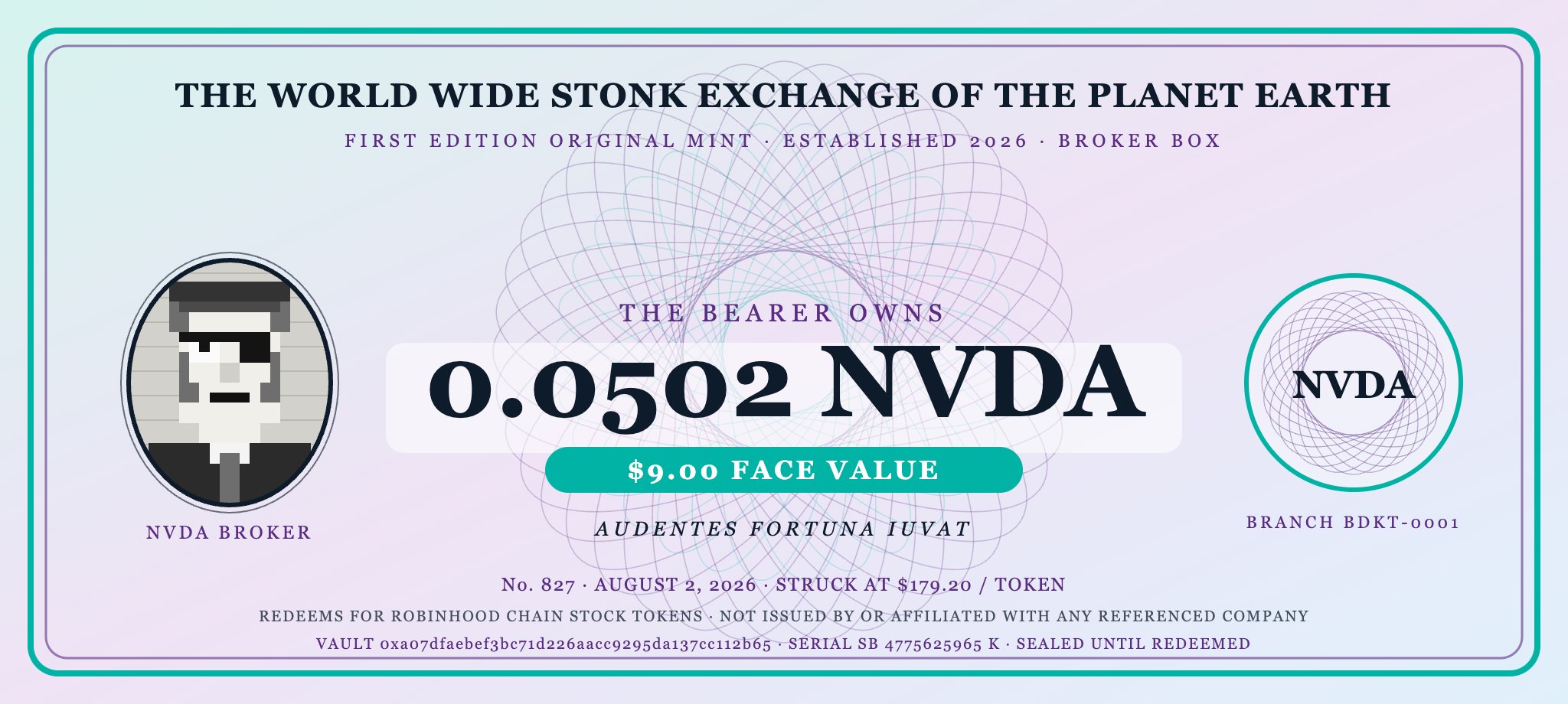
7.1K @web3gatsby I just tested sending some tokenized $NVDA through the Stonk Brokers certificate counter directly to my wife via email for her to claim without the need of a wallet of any sort. This is an incredible onboarding tool for normies and for creating a email savings account.
Alternatively you can fill an email with a bunch of these periodically and give access to that email to your kids when they turn 18, or to anyone for that matter!
Gud tec. Stonks
 89
89
 15
15
 4.5K
4.5K
2026-08-02 02:57
Trend of NVDA after release
Extremely Bullish
Sending tokenized NVDA via email without a wallet, praised as an excellent onboarding and savings tool for beginners.

Jim Liu
FA_Analyst
Researcher
S
34.4K @jiahanjimliu Neutral
NVDA Kyber delay, revenue impacted by single‑digit figures
$NVDA: Kyber Delays?
Kyber is the rack architecture for VR300, not the current release of VR200 which will use the Oberon racks.
I appreciate @Aaronwei3n for sticking to his guns on Kyber delay rumors. Nvidia will not announce until it has to but Aaron is boots on the ground and seeing the signs now already due to orthogonal midplane difficulty.
Note there is nothing wrong with state of the art GPU system level delays as that is normal with such a complex system. Aaron himself states single digit percentage impacts to revenue for $NVDA. Suppliers may get impacted more majorly.
Interest to $IREN investors is that we will need 600kW rack density and 800V DC power distribution system. @FransBakker9812 for viz.
Not that $INV is not the provider of two stage cooling for Kyber but rather Asia Vital Components (3017 TT) and Cooler Master. @MarkosAAIG @MB_Hogan for viz.
Jim Liu
FA_Analyst
Researcher
S
34.4K @jiahanjimliu Nvidia has denied but I believe Aaron and @SemiAnalysis_ on this one. https://t.co/G8pUMYSmL6
28
5
11.6K
2026-07-22 05:27
Trend of NVDA after release
Neutral
NVDA Kyber delay, revenue impacted by single‑digit figures

materkel.gwei 🦇🔊
DeFi_Expert
Tokenomics_Expert
B
6.2K @materkel Extremely Bullish
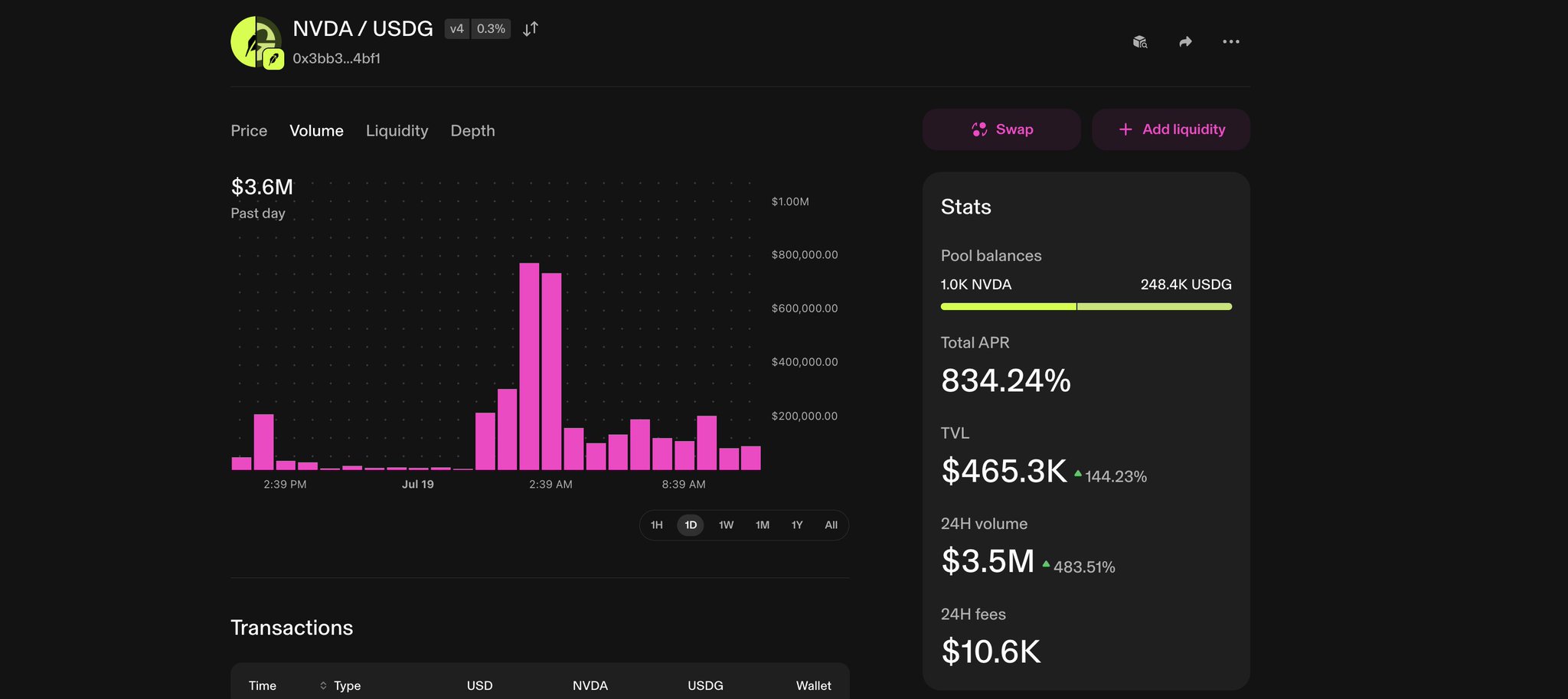
NVDA/USDG Uniswap V4 pool becomes the largest RWA pool on the Robinhood chain, with a huge increase in trading volume and TVL.

Hayden Adams 🦄 D
1.7M @haydenzadams Update: the numbers are going up quickly
the largest rwa pool on Robinhood chain is now a NVIDA/USDG Uniswap v4 pool with $3.5m in daily trading volume https://t.co/63nreUxh0T
 819
132
202.4K
819
132
202.4K
2026-07-20 19:47
Trend of NVDA after release
Extremely Bullish
NVDA/USDG Uniswap V4 pool becomes the largest RWA pool on the Robinhood chain, with a huge increase in trading volume and TVL.
Price Prediction
When is a good time to buy NVDA? Should I buy or sell NVDA now?
When deciding whether it’s a good time to buy or sell NVIDIA (Derivatives) (NVDA), it’s important to first align with your own trading strategy and risk profile.Long-term investors and short-term traders often interpret market conditions differently, so your decision should reflect your personal approach. According to the latest NVDA 4-hour technical analysis, the current trading signal is Hold. According to the latest NVDA 1-day technical analysis, the current signal is Hold.

Beacon Prediction
Probabilistic Price Forecast (Next 24 Hours)Beacon Prediction Disclaimer
The data results displayed on this page are analyzed based on actual trading data (OHLCV) of the selected trading pair along with corresponding technical indicators.
This prediction is an experimental technical product and is provided for reference purposes only. It does not constitute investment advice. Unexpected real-world events may significantly impact market behavior. Traders should make decisions with caution.
This prediction is an experimental technical product and is provided for reference purposes only. It does not constitute investment advice. Unexpected real-world events may significantly impact market behavior. Traders should make decisions with caution.
About NVIDIA (Derivatives)
NVIDIA (Derivatives) (NVDA) is a cryptocurrency . NVIDIA (Derivatives) has a current supply of 0. The last known price of NVIDIA (Derivatives) is 236.08650978 USD and is up 0.48 over the last 24 hours. It is currently trading on 107 active market(s) with $212,945.52 traded over the last 24 hours.
Read More