


LISTA Swing/Spot play.
Entry zone : 0.046 - 0.049
TPs: 0.053 / 0.0541 / 0.057 / 0.064 / 0.071 / 0.079 / 0.088 / 0.094
Sl 0.044
活動
合約每日抽獎
每日交易100%中獎
現貨每日抽獎
抽 8,888 USDT 豪禮
投票上幣
投票支持區塊鏈資產,賺取空投
機構
專為機構打造的解決方案
VIP
解鎖專屬福利
BitMart 學院
快速學習入門交易,瞭解區塊鏈知識
BitMart 大使
學習、建設 Web3,從 BitMart 起航
BitMart Travel
全球旅行服務,一站式預訂
BitMart話費充值
話費、流量、套餐便攜充值
轉帳
安全便捷,隨時隨地全球匯款
幣市商城
用加密貨幣滿足您的一切消費需求
Lista DAO 實時價格數據
今日Lista DAO的實時價格為$ 0.089 (LISTA/USD), 當前市值為 $ 42.37M USD。 24小時的成交量為 $ 2.03M USD。 過去24小時內漲跌幅為 +12.50%, 流通量為 470.82M LISTA。
Lista DAO LISTA 價格歷史 USD
跟蹤 Lista DAO 的今日價格、7天、30天和90天價格
週期
漲跌
漲跌幅 (%)
今日
$ 0.0099
12.50%
7日
--
--
30日
--
--
90日
--
--
Lista DAO 市場信息
$ 0.079 24小時價格浮動區間 $ 0.089
歷史最高
$ 0
歷史最低
$ 0
24小時漲跌幅
12.50%
24小時交易量
$ 2,030,443.88
流通供給
254.61M
LISTA
市值
$ 22.91M
最大供給
1.00B
LISTA
完全稀釋的市值
$ 89.99M
交易 LISTA
Lista DAO 社交媒體動態

CryptoDoc
TA_Analyst
Trader
C
 79.3K @cryptodoc_
 看漲
Buy LISTA in the 0.046‑0.049 range, target price 0.088 bullish
 12
12
 4
4
 7.5K
7.5K
2026-07-03 07:57
發佈後LISTA走勢
看漲
Buy LISTA in the 0.046‑0.049 range, target price 0.088 bullish

토큰포스트 - TokenPost Korea
Media
Researcher
D
5.9K @tokenpostkr 看漲
ListaDAO clarifies that the third‑party contract vulnerability does not affect its own core contracts.
ListaDAO "The reported vulnerable contract was created by a third party... no damage to our contract"
https://t.co/mmhmCijtZr https://t.co/anbyjftfT7
 0
0
23
0
0
23
2026-04-17 06:12
發佈後LISTA走勢
看漲
ListaDAO clarifies that the third‑party contract vulnerability does not affect its own core contracts.

机灵的杰尼君🔶BNB
Trader
Derivatives_Expert
C
108.1K @Meta8Mate 極度看漲
Lista DAO fixed-rate lending strategy, using PT-sUSDe to achieve near-zero-cost borrowing, with high yield potential.
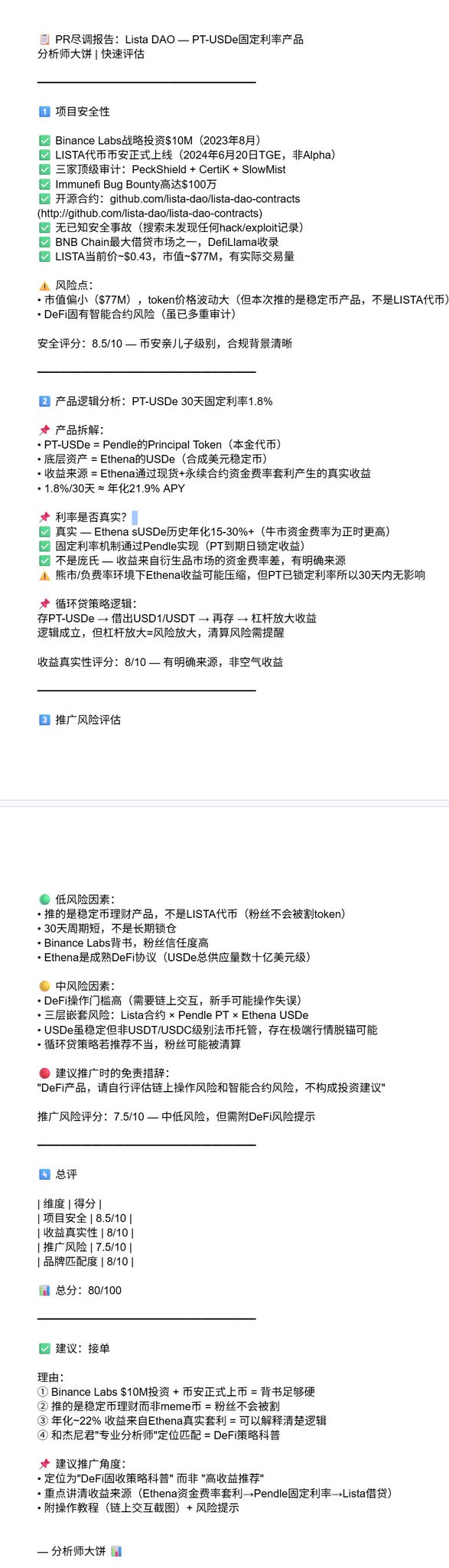
Using Jeni Jun's Little Lobster team @openclaw conducted due diligence on @lista_dao, and the process was somewhat surprising.
Project safety, yield authenticity, promotional risk, brand match – all were completed in minutes, each with clear conclusions.
Suddenly realized: this setup is naturally suited for the crypto space; once AI due diligence becomes the norm, RUG projects will have nowhere to hide — it’s another form of “good money drives out bad money”.
Crypto retail investors get rug pulled not often because they don’t understand, but because of information asymmetry. AI can fill this gap, even partially, and I think it’s worthwhile.
Of course, I’m not saying AI due diligence is omnipotent; it can also be fooled, but it raises the cost of malicious behavior.
Do you think AI can reduce your chances of being rug pulled?
机灵的杰尼君🔶BNB
Trader
Derivatives_Expert
C
108.1K @Meta8Mate The 杰尼君OpenClaw team, after detailed research, brings the first project @lista_dao. The due diligence report will be posted in the comments later and serves as a comprehensive project investigation for reference.
***
Recently, the Lobster team conducted a DeFi project study; the product logic is rather unique and deserves a dedicated explanation.
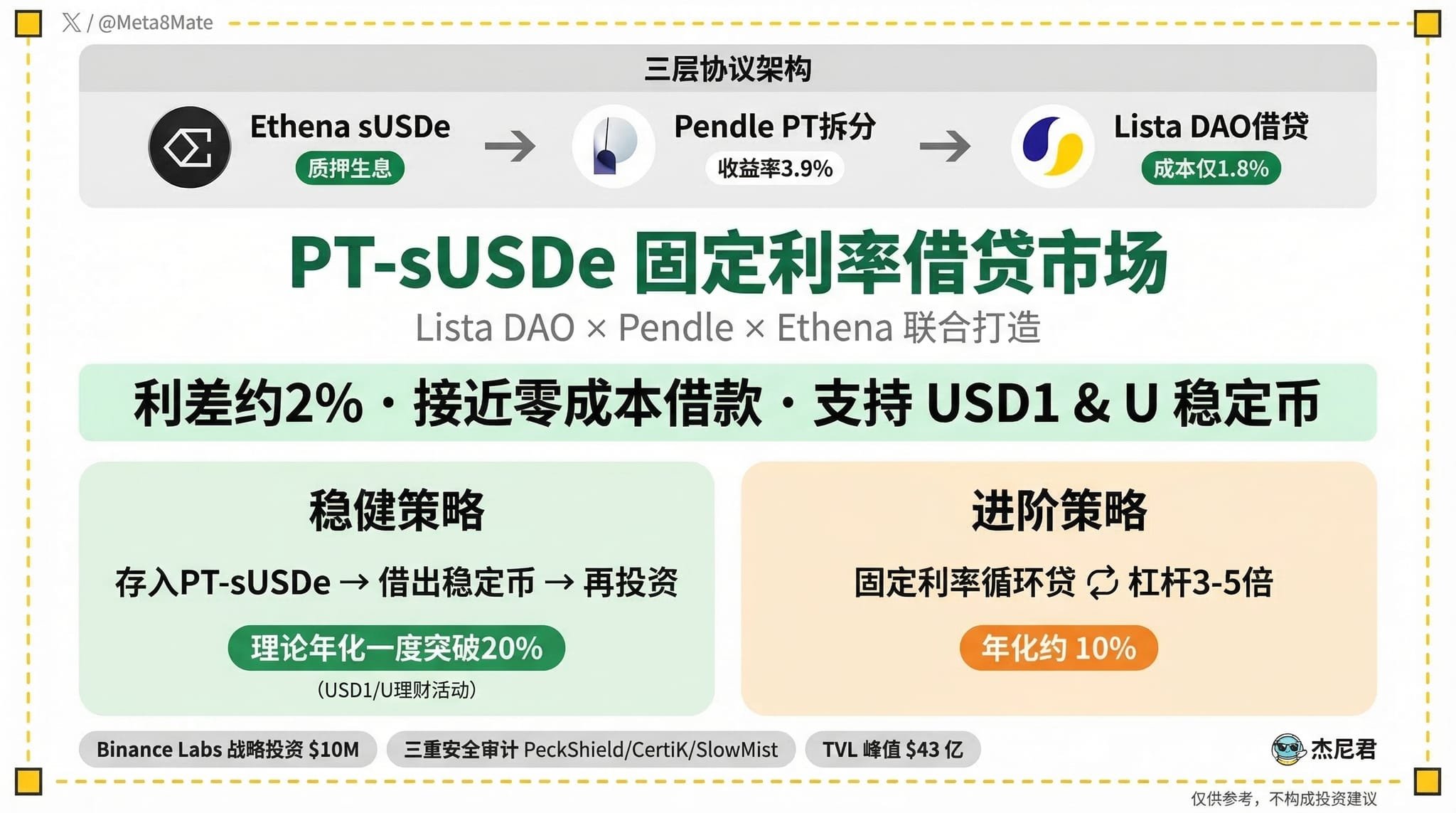
The product is Lista DAO @lista_dao's PT-sUSDe fixed-rate lending market. The core selling point is: your collateral earns money while the borrowing cost is almost fully covered — near‑free borrowing.
Let's break down the three-layer protocol:
Layer 1: Ethena's $sUSDe
$sUSDe is Ethena's staked synthetic USD. It captures funding rates by holding spot BTC/ETH and shorting an equal amount of perpetual contracts, then adds ETH staking rewards. Historically it yielded 10‑20%+ annualized; currently about 3.5% annualized. In short, it is a stablecoin that generates its own interest.
Layer 2: Pendle's split
Pendle is the leading protocol in the DeFi fixed‑income space. It splits sUSDe into two tokens.
PT-sUSDe is the principal token, bought at a discount and redeemed 1:1 for sUSDe at maturity, similar to a zero‑coupon bond in DeFi. Current fixed annual yield is about 3.7‑3.9%, with a maturity around April 9 2026. The return is locked in advance and not affected by subsequent sUSDe rate fluctuations.
YT is the yield token that captures all variable returns; it is a high‑risk, high‑leverage product and is out of scope for this discussion.
Layer 3: New feature of Lista DAO
Lista DAO is one of the largest lending + CDP + liquidity‑staking protocols on BNB Chain. Binance Labs made a strategic investment of $10M in 2023, TVL peaked at $4.3 billion, token $LISTA launched on Binance Launchpool in June 2024, audited by PeckShield, CertiK and SlowMist, with a $1 million Immunefi bug bounty, and no security incidents to date.
The newly launched feature allows using PT-sUSDe as collateral to borrow $U or $USD1 stablecoins at a fixed annual cost of roughly 1.8%. Two markets are supported; you can choose which stablecoin to borrow as needed.
Core logic:
PT-sUSDe carries an inherent fixed annual yield of about 3.9%, while Lista’s borrowing cost is only about 1.8% annualized — fixed.
The spread is roughly 2%, meaning the earnings on the collateral each year are enough to cover the borrowing interest, with surplus left over.
In other words, the borrowed stablecoin is obtained at almost zero cost; using that capital elsewhere yields pure spread profit.
Two strategies in detail:
Strategy 1 (conservative): collateral‑then‑invest
Step 1: Deposit PT-sUSDe into Lista as collateral.
Step 2: Borrow USD1 or U at a fixed 1.8% annual rate.
Step 3: Deposit the borrowed stablecoin into Binance Savings (USD1 once had a 20% annual promotion) or other CEX savings products.
Step 4: When PT matures (around April 9), redeem sUSDe 1:1, repay the loan, and settle profits.
Advantages of this strategy: dual‑layer yield stacking, no active management needed, PT auto‑settles at maturity, clear logic, suitable for users who do not want to constantly manage positions.
Strategy 2 (advanced): fixed‑rate circular lending
Step 1: Deposit PT-sUSDe as collateral and borrow stablecoins.
Step 2: Swap the stablecoins for sUSDe, then buy more PT-sUSDe on Pendle.
Step 3: Deposit the newly bought PT back into Lista, borrow again, and repeat.
Step 4: Theoretical leverage of 3‑5×, estimated net annual return about 10%.
The core value of this strategy lies in the fixed rate: the borrowing cost of 1.8% annualized is locked, regardless of market rate changes, so your borrowing cost does not increase and you won’t be forced to liquidate due to rate swings. This is the biggest difference between fixed and variable rates — predictable cost and executable strategy.
What is USD1: USD1 is a USD‑pegged stablecoin issued by World Liberty Financial (WLFI). It launched on Binance at the end of 2025 and is currently the second‑largest borrowed asset on Lista.
⚠️ Risks must be taken seriously:
Maturity mismatch risk: PT matures around April 9; loan terms should align, otherwise exiting PT early incurs a discount loss.
Liquidation risk: Fixed rate does not mean risk‑free; a drop in PT price mid‑term can still trigger liquidation, which is often overlooked.
Three‑layer contract nesting: Lista × Pendle × Ethena; an issue in any layer affects the whole, and while Lista has triple audits, zero risk is not guaranteed.
Circular lending risk: Leverage amplifies both returns and liquidation exposure; not recommended for those without DeFi experience.
Opportunity cost: Funds are locked until PT matures and cannot be exited without loss.
***
This is the research share from 杰尼君 and the Lobster team. All data are as of the research date, do not constitute investment advice, principal loss risk exists, please assess yourself, DYOR.
@lista_dao @Ethena_Eco @pendle_fi @ethena
 16
11
6.2K
16
11
6.2K
2026-03-11 02:51
發佈後LISTA走勢
極度看漲
Lista DAO fixed-rate lending strategy, using PT-sUSDe to achieve near-zero-cost borrowing, with high yield potential.
價格預測
什麼時候是購買LISTA的好時機?我應該現在買入還是賣出LISTA?
在判斷現在是否是買入或賣出 Lista DAO (LISTA) 的合適時機時,首先需要結合自身的交易策略和風險承受能力。長期投資者與短期交易者對市場信號的解讀往往不同,因此建議根據個人交易計劃做出決策。 根據最新的 LISTA 4 小時技術分析,當前交易信號為持有。

Beacon預測
概率價格預測(未來24小時)Beacon預測免責聲明
當面頁面的數據結果基於當前交易對的實際交易數據(OCHLV)和相應的指標計算,然後進行分析得出結果。
此預測為實驗性技術產品,僅供參考,不構成投資建議。現實生活中的任何突發事件都可能對交易行為產生重大影響,因此交易者應謹慎決策。
此預測為實驗性技術產品,僅供參考,不構成投資建議。現實生活中的任何突發事件都可能對交易行為產生重大影響,因此交易者應謹慎決策。
關於 Lista DAO
Lista DAO (LISTA) is a cryptocurrency launched in 2022and operates on the BNB Smart Chain (BEP20) platform. Lista DAO has a current supply of 795,588,564.255041 with 470,820,198.7744087 in circulation. The last known price of Lista DAO is 0.08840247 USD and is up 1.87 over the last 24 hours. It is currently trading on 181 active market(s) with $2,634,929.24 traded over the last 24 hours. More information can be found at https://lista.org/.
查看更多
購買 LISTA
交易 LISTA